Chapter 24 - Quotes on National Debt
Who has the authority to create the money of the nation? One might assume that the answer is the government. The government gets the blame for poor economic management as the debt builds up. But there is little place for the debt load to go but up. So the trick is to let the debt rise. It is, after all, unpayable. So let it remain unpaid. The lenders do not wish for default otherwise, they will lose money, so they have to tolerate the constantly rising debt. Play the lenders at their own game. Borrow and issue bonds as needed. A good reason for implementing the current system is to prevent the government issuing too much money. If a government has to borrow, it only borrows as much as it needs.
This system is considerably different to the systems of the past where the sovereign or government created the money of the nation then spent it into circulation. To prevent oversupply, the government taxed the excess out of circulation. The sovereign does not need to tax because he needs money because he can create as much as he needs. The sovereign taxes to prevent oversupply. The sovereign could never be in debt for his own money, but he could get into debt for gold for foreign transactions and foreign wars. There were some other issues with the sovereign money system. The sovereign might spend in fits and starts and tax irregularly giving an inconsistent Money Supply. The sovereign has no provision to assist business startups and business expansion. This is currently done with bank credit. It is feasible that these might be overcome with better management. The delicacies of Money Supply management was not understood then and is not understood at present.
Our current experiment is a continuation of the five thousand year experiment in the use of money. It also has faults. We can get round some of the faults, but not all of them. Unpayable debt can be mitigated by inflation. The national debt can all but be ignored. The power of the lending industry tends to become overwhelming. Their buildup of wealth, as they appropriate all forms of wealth, including land, becomes unstoppable. Their political influence extends into any political party that has a chance of incumbency. This group tends to make assumptions about the continuance of the system and this is where they come unstuck, often coming to a sticky end. They should heed the warnings and not assume that they can assume all power in the political process. They should not assume that it is acceptable to accumulate wealth to the detriment of others. The poor will react irrespective of the legality of their actions. There is ethics involved in this. High ethics eventually overrides unjust rules.
National debt is but one component of the current system. The government has the authority to create money but has delegated the power to private interests using the central bank as a cover. Here are some historical comments about national debt, many of which are by respected presidents. History tends to judge people as good or bad. I hope President Trump will operate the system so that he will be remembered as a truly great president. He is bright enough to realize that he will be remembered in the future as a truly great president or a puppet of the moneyed class. He has the skills and experience to be remembered as one of the greatest and break away from the situation posed in ‘The Wonderful Wizard of Oz’. In this clever book written one hundred years ago, the Yellow Brick Road represented ‘following the gold standard’. ‘The Wizard of Oz’ was the president of the United States and he was having his strings pulled by the ‘Wicked Witch’. ‘The Wicked Witch’ represented the Wall Street banks. Is he man enough to stand up to the lobbyists? This appears on his election campaign page:
Trump Pledges To Drain The Swamp And Impose Congressional Term Limits 2016-10-18
There is another major announcement I am going to make today as part of our pledge to drain the swamp in Washington. If I am elected President, I will push for a Constitutional Amendment to impose term limits on all members of Congress.
Decades of failure in Washington, and decades of special interest dealing must come to an end. We have to break the cycle of corruption, and we have to give new voices a chance to go into government service. The time for Congressional term limits has arrived.
...
It is time to drain the swamp in Washington, D.C.
That is why I am proposing a package of ethics reforms to make our government honest once again.
First: I am going to institute a 5-year ban on all executive branch officials lobbying the government after they leave government service.
Second: I am going to ask Congress to institute its own 5-year ban on lobbying by former members of Congress and their staffs.
Third: I am going to expand the definition of lobbyist so we close all the loopholes that former government officials use by labeling themselves consultants and advisors when we all know they are lobbyists.
Fourth: I am going to issue a lifetime ban against senior executive branch officials lobbying on behalf of a foreign government.
Fifth: I am going to ask Congress to pass a campaign finance reform that prevents registered foreign lobbyists from raising money in American elections.” [https://www.donaldjtrump.com/press-releases/trump-pledges-to-drain-the-swamp]
This is a truly tremendous policy. I would go further and make it a permanent ban on politicians acting as lobbyists. The JFK assassination was a lesson to future presidents to be careful of those with real power. This man is being very brave.
 National Debt is money owed by the government to creditors. It is usually in the form of Bonds or occasionally debt to private banks. Bonds are a promise to repay an amount in the future and pay interest on the money borrowed. Bonds are loans that have flexible ownership as they can be transferred from creditor to creditor. Where a government borrows from a Public Bank the situation is entirely different. Because the Public Bank is owned by the government, the debt is somewhat irrelevant because the government owes money to the government. Interest accrues to the government. Unfortunately, it appears in statistics as a National Debt and distorts the truth. China is smart enough to use this system.
John Adams (1797-1801) Second President of the United States
“There are two ways to enslave a nation. One is by the sword. The other is by debt.”
William Cobbett 1804
“Nothing is so well calculated to produce a death-like torpor in the country as an extended system of taxation and a great national debt.” [1]
Herbert Hoover 1936
“Blessed are the young for they shall inherit the national debt.” [2]
Benjamin Franklin 1706-1790
“Think what you do when you run in debt; you give to another power over your liberty.” [3]
Thomas Jefferson 1816
“I place economy among the first and most important of virtues, and public debt as the greatest of dangers to be feared.”
“To preserve our independence we must not let our leaders load us with perpetual debt. ... If we can prevent the government from wasting the labors of the people under the pretense of caring for them, we will be wise.” [4]
Thomas Edison 1921
“It is absurd to say that our country can issue $30 000 000 in bonds and not $30 000 000 in currency. Both are promises to pay; but one promise fattens the usurer, and the other helps the people. If the currency issued by the Government were no good, then the bonds issued would be no good either. It is a terrible situation when the Government, to increase the national wealth, must go into debt and submit to ruinous interest charges at the hands of men who control the fictitious values of gold.”
Thomas Jefferson 1816
“The system of banking we have both equally and ever reprobated. I contemplate it as a blot left in all our constitutions, which, if not covered, will end in their destruction, which is already hit by the gamblers in corruption, and is sweeping away in its progress the fortunes and morals of our citizens. Funding I consider as limited, rightfully, to a redemption of the debt within the lives of a majority of the generation contracting it; every generation coming equally, by the laws of the Creator of the world, to the free possession of the earth he made for their subsistence, unencumbered by their predecessors, who, like them, were but tenants for life. And I sincerely believe, with you, that banking establishments are more dangerous than standing armies; and that the principle of spending money to be paid by posterity, under the name of funding, is but swindling futurity on a large scale.” [4]
George McGovern, U.S. Senator
“When I was a youngster growing up in South Dakota, we never referred to the national debt, it was always referred to as the war debt because it stemmed from World War I.” [7]
Thomas Jefferson
“And to preserve their independence, we must not let our rulers load us with perpetual debt. We must make our election between economy and liberty, or profusion and servitude. If we run into such debts, as that we must be taxed in our meat and in our drink, in our necessaries and our comforts, in our labors and our amusements, for our callings and our creeds, as the people of England are, our people, like them, must come to labor sixteen hours in the twenty-four, give the earnings of fifteen of these to the government for their debts and daily expenses; and the sixteenth being insufficient to afford us bread, we must live, as they now do, on oatmeal and potatoes; have no time to think, no means of calling the mismanagers to account; but be glad to obtain subsistence by hiring ourselves to rivet their chains on the necks of our fellow-sufferers.” [8]
In the next quote, Roosevelt is talking about a public bank owned by the government where the debt is owed by the government to the government.
Franklin D Roosevelt 1939
“Our national debt after all is an internal debt owed not only by the Nation but to the Nation. If our children have to pay interest on it they will pay that interest to themselves. A reasonable internal debt will not impoverish our children or put the Nation into bankruptcy.”
Abraham Lincoln 1843
“For several years past the revenues of the government have been unequal to its expenditures, and consequently loan after loan, sometimes direct and sometimes indirect in form, has been resorted to. By this means a new national debt has been created, and is still growing on us with a rapidity fearful to contemplate--a rapidity only reasonably to be expected in a time of war. This state of things has been produced by a prevailing unwillingness either to increase the tariff or resort to direct taxation. But the one or the other must come. Coming expenditures must be met, and the present debt must be paid; and money cannot always be borrowed for these objects. The system of loans is but temporary in its nature, and must soon explode. It is a system not only ruinous while it lasts, but one that must soon fail and leave us destitute. As an individual who undertakes to live by borrowing soon finds his original means devoured by interest, and, next, no one left to borrow from, so must it be with a government. We repeat, then, that a tariff sufficient for revenue, or a direct tax, must soon be resorted to; and, indeed, we believe this alternative is now denied by no one. [Whig circular 1843]
Thomas Paine 1791
“The burden of the national debt consists not in its being so many millions, or so many hundred millions, but in the quantity of taxes collected every year to pay the interest. If this quantity continue the same, the burden of the national debt is the same to all intents and purposes, be the capital more or less.” [9]
Frederick Soddy 1921
“There is nothing left now for us but to get ever deeper and deeper into debt to the banking system in order to provide the increasing amounts of money the nation requires for its expansion and growth. An honest money system is the only alternative.” [6]
The U.S. has an arrangement called a ‘debt limit’. This is not to prevent excessive debt from occurring but to allow increasing debt. The ‘debt limit’ arrangement was started in 1917. The one thing that it has never done it to limit the level of debt.
The Grace Commission Report 1984
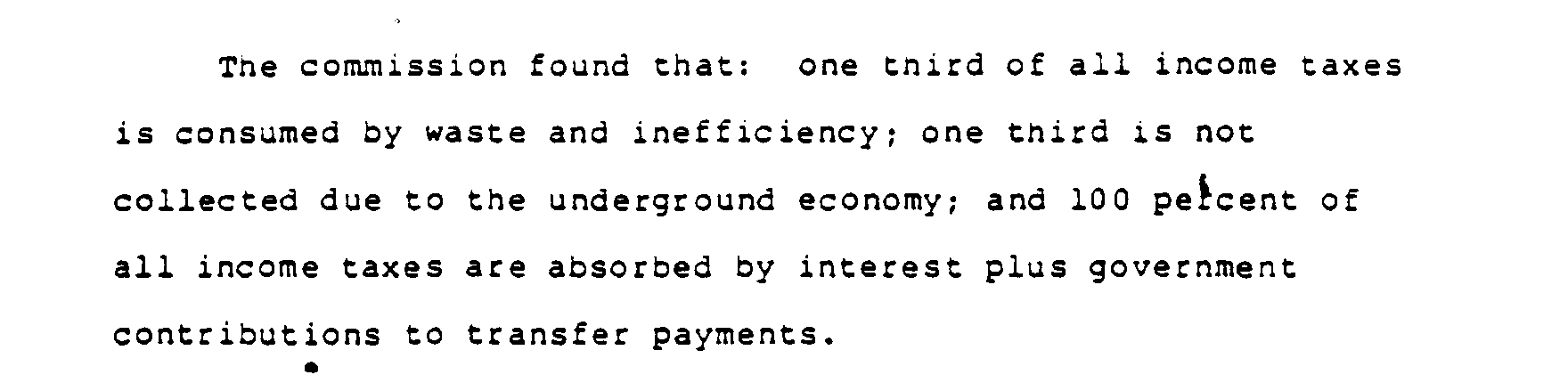
This was a President Ronald Reagan authorized report presented to the U.S. Congress. It contained this information: “One hundred percent of what is collected as federal income tax is absorbed solely by interest on the federal debt and by federal government contributions to transfer payments.” [10] This means that all individual income tax revenues are gone before any money is spent on the services taxpayers expect from their government. This is an admission that none of the funds they collect as federal income taxes is used to pay for federal government services.
[10]
President Ronald Reagan, 1983, Williamsburg
“Our federal tax system is, in short, utterly impossible, utterly unjust and completely counterproductive [it] reeks with injustice and is fundamentally un-American... it has earned a rebellion and it’s time we rebelled”
Jimmy Carter 1976 by the then President-to-be
“Our Income Tax system is a disgrace to the human race.”